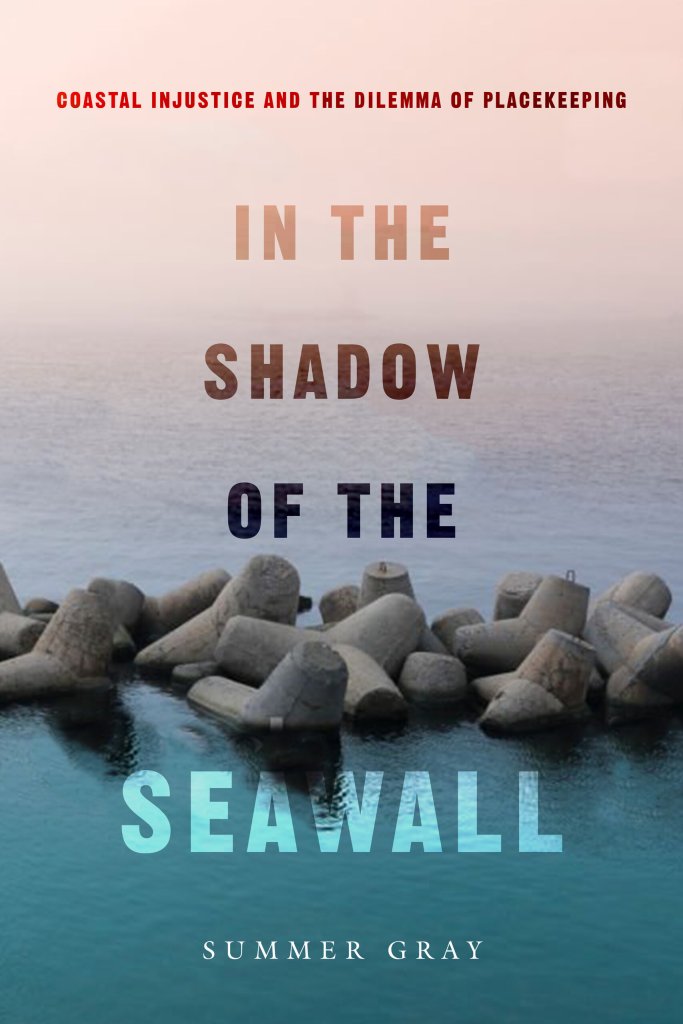
In the Shadow of the Seawall: Coastal Injustice and the Dilemma of Placekeeping
Available from University of California Press
A remarkable book. Climate change is reducing the amount of our earth safe for human habitation, and this volume—with its particular focus on coastal communities—catches the injustice, poignance, and possibility that these shifts present. Placekeeping will become a watchword going forward.
—Bill McKibben, author, educator, environmentalist, and Co-founder of 350.org
In the Shadow of the Seawall journeys to the low-lying lands of Guyana and the Maldives to grapple with the existential dilemma of seawalls alongside struggles to resist displacement. With the gathering momentum of ocean instability wrought by centuries of injustice, seawalls have become objects of conflict and negotiation, around which human struggles for power and resistance collide. As frontline communities address ruination by envisioning environmentally sustainable alternatives to seawalls, the concept of placekeeping emerges—a justice-oriented framework for addressing adaptation and the global dangers of coastal disruption. Drawing on ethnographic observation and interviews, Gray shows how seawalls are entrenched in relationships of power and entangled in processes of making and keeping place.
REVIEWS
In this evocative critical sociology of climate adaptation and resilience, Summer Gray invites us to appreciate the struggles by which the least powerful try to stay in place. Comparing struggles for climate justice in the low-lying lands of Guyana and the Maldives, Gray reveals seawalls to be multivalent sites for people to negotiate colonial oppression, resist racial capitalism, maintain livelihoods, and fight for democracy and sovereignty. With no easy solutions to climate change as communities face complex experiences of attachment to place and the anxiety of anticipated loss, persistence in mutual support may be the best way to respond to global inequality, climate injustice, and uneven adaptation.
—Mimi Sheller, author of Island Futures: Caribbean Survival in the Anthropocene
In the Shadow of the Seawall renders and clarifies the stakes of important dilemmas surrounding climate change adaptation, with a particular focus on seawalls as infrastructures that both make and mark longer histories of inequality and power, operating at multiple scales. Summer Gray productively places the idea of placekeeping at the root of the discussion, allowing readers to see the contradictions and ambivalence attendant to holding on to where you are.”
—Rebecca Elliott, author of Underwater
Based on extensive research in Guyana and the Maldives and countless interviews, Summer Gray’s In the Shadow of the Sea Wall documents the complexity of sea level rise. Gray takes into account the inequities created by colonialism that establish unequal footing, as well as the differing intentions of leaders and the wishes of communities impacted. A must-read for anyone interested in sea level rise and coastline communities.
—Christina Gerhardt, author of Sea Change: An Atlas of Islands in a Rising Ocean
Summer Gray’s (2014) research, which has been published as a book (Gray 2023), takes a different approach to seawalls and coastal defense, engaging in a multisited project that starts in the Netherlands and ends in the Maldives. Gray’s is a “study of human-altered landscapes, climate change, and the stories of men and women who live behind walls at the edge of the sea” (2014: 2). She writes: “As melting ice and shifting coastlines intersect with human borders, lived experiences, and embedded histories, those who dwell behind seawalls can perhaps provide a glimpse into the precarious world of life in the anthropocene. Here, manufactured walls enable people to resist sea change by gambling with the dangers and unknown costs of human-altered landscapes” (Gray 2014: 53).
—Ryan Anderson, “Time, Seawalls, and Money” in Environment and Society
MEDIA COVERAGE
According to the sociologist Summer Gray, seawalls are less a practical solution than a product of technocratic ideology—one that colonial powers have exported around the world. For all their potential benefits, seawalls “harm the environment, shift vulnerability downstream, lead to the disappearance of the beach, and create cycles of dependency,” she writes in her new book, “In the Shadow of the Seawall” (University of California Press). In one meticulous chapter, Gray recounts how the Dutch West India Company settled the low-lying coast of Guyana, in South America. Planters enslaved Africans, who were forced to build seawalls and then to cultivate sugarcane. The people of Guyana eventually came to see their aging seawalls as a necessity; there was now significant development on low-lying land. When storms surge over our protections, we tend to wonder why they weren’t higher, rather than questioning the logic of living by the sea.
—Daniel A. Gross, “Can Seawalls Save Us?” The New Yorker Magazine

Excerpt can be found here: https://coastalcare.org/2023/11/can-seawalls-save-us-the-new-yorker/
How much time, energy and resource will we spend trying to maintain life and business as we know it in the face of unrelenting climatic change? How might it shift how we relate to and value the coast? In addition to raising those questions and others like them, for UC Santa Barbara sociologist Summer Gray, rising seas do something else: They expose age-old social injustices and inequalities and offer them up for examination. In her first book, “In the Shadow of the Seawall” (University of California Press, 2023), Gray takes two communities that are on the front lines of sea level rise — the Maldives, an island country in the north-central Indian Ocean, and Guyana, an Atlantic Ocean-facing nation in the northeastern corner of South America — and studies how seawalls serve as a point of conflict between rich and poor, colonizer and Indigenous, powerful and powerless.
—Sonia Fernandez, “In the Shadow of the Seawall” The UCSB Current
 SUMMER GRAY